Table of Contents
ToggleGanesh Chaturthi: History, Significance, Traditions and Celebrations
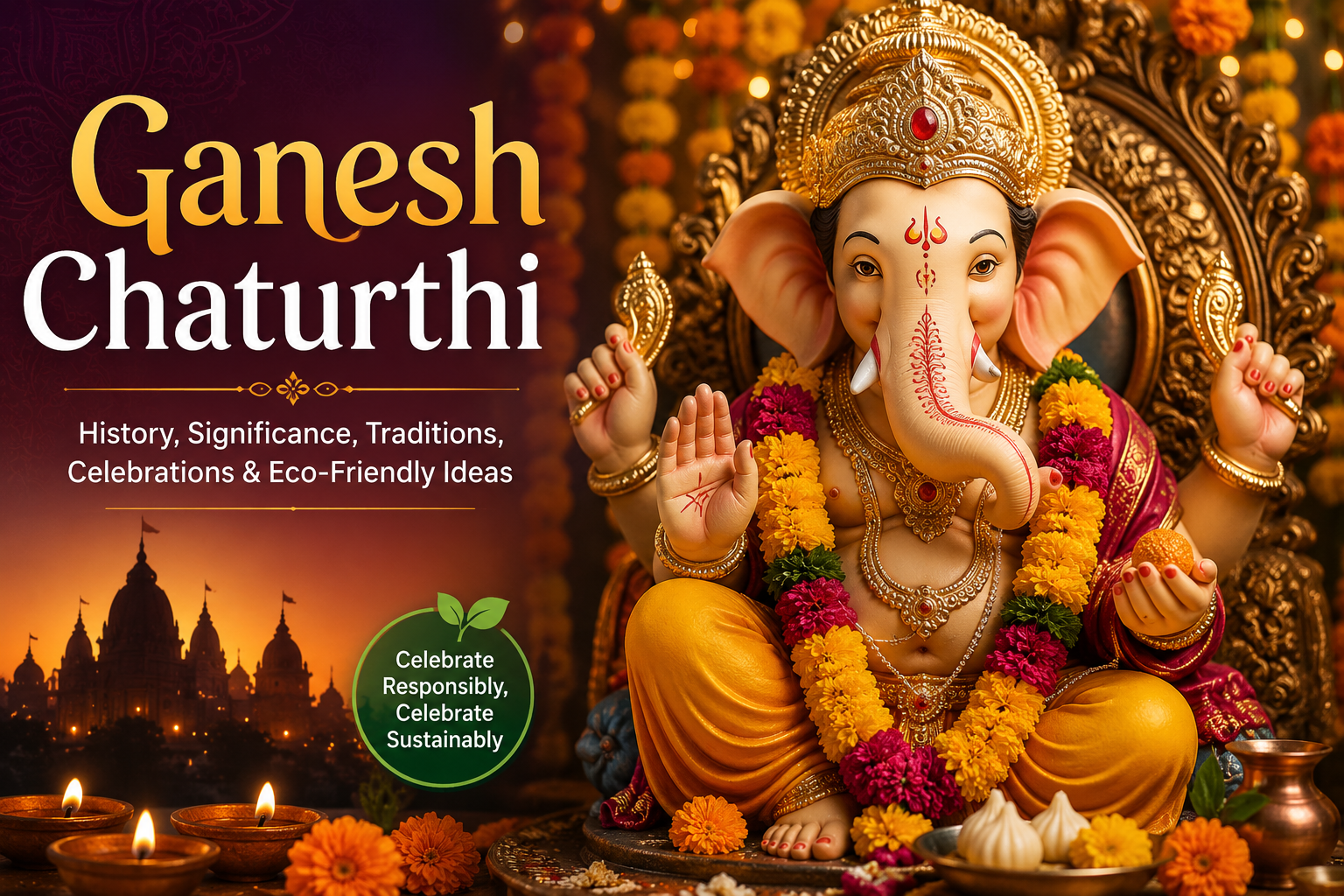
Every year, as the monsoon season begins to fade and the festive spirit starts filling the streets, homes across India welcome Lord Ganesha with great devotion and excitement. The arrival of beautifully decorated Ganesha idols, the sound of devotional music, colourful decorations, and the aroma of freshly prepared modaks all mark the beginning of one of India’s most beloved festivals — Ganesh Chaturthi.
Also known as Vinayaka Chaturthi, the festival celebrates the birth of Lord Ganesha, the Hindu deity associated with wisdom, prosperity, good fortune, and the removal of obstacles. For many devotees, Ganesh Chaturthi is more than a religious celebration. It is a time when families come together, communities celebrate as one, and streets come alive with art, music, food, and devotion.
From small household celebrations to grand public festivities, the festival has become an important part of India’s cultural identity. While Maharashtra is particularly famous for its grand Ganesh Chaturthi celebrations, the festival is observed with devotion in many parts of the country.
Let’s explore the history, significance, traditions, celebrations, and changing face of Ganesh Chaturthi.
Here is the popular सुखकर्ता दुःखहर्ता गणपती आरती in Marathi:
What Is Ganesh Chaturthi?
Ganesh Chaturthi is a Hindu festival dedicated to Lord Ganesha. It is celebrated on the fourth day (Chaturthi) of the Hindu lunar month of Bhadrapada, which usually falls during August or September.
The festival traditionally begins with the installation of a Ganesha idol in homes, temples, and community pandals. Devotees perform prayers and rituals throughout the celebration. Depending on family and regional traditions, the idol may remain in the home or pandal for different lengths of time.
The celebration concludes with Ganesh Visarjan, when the idol is carried in a procession and immersed in water. The immersion symbolises the return of Lord Ganesha to his divine abode and reminds devotees of an important idea: everything in life is temporary, and we must learn to accept change and let go.
The festival combines spirituality with community celebration. It can be intimate and simple inside a family home or spectacular on the streets, where enormous idols and elaborate pandals attract thousands of visitors.
The Story Behind Lord Ganesha's Birth
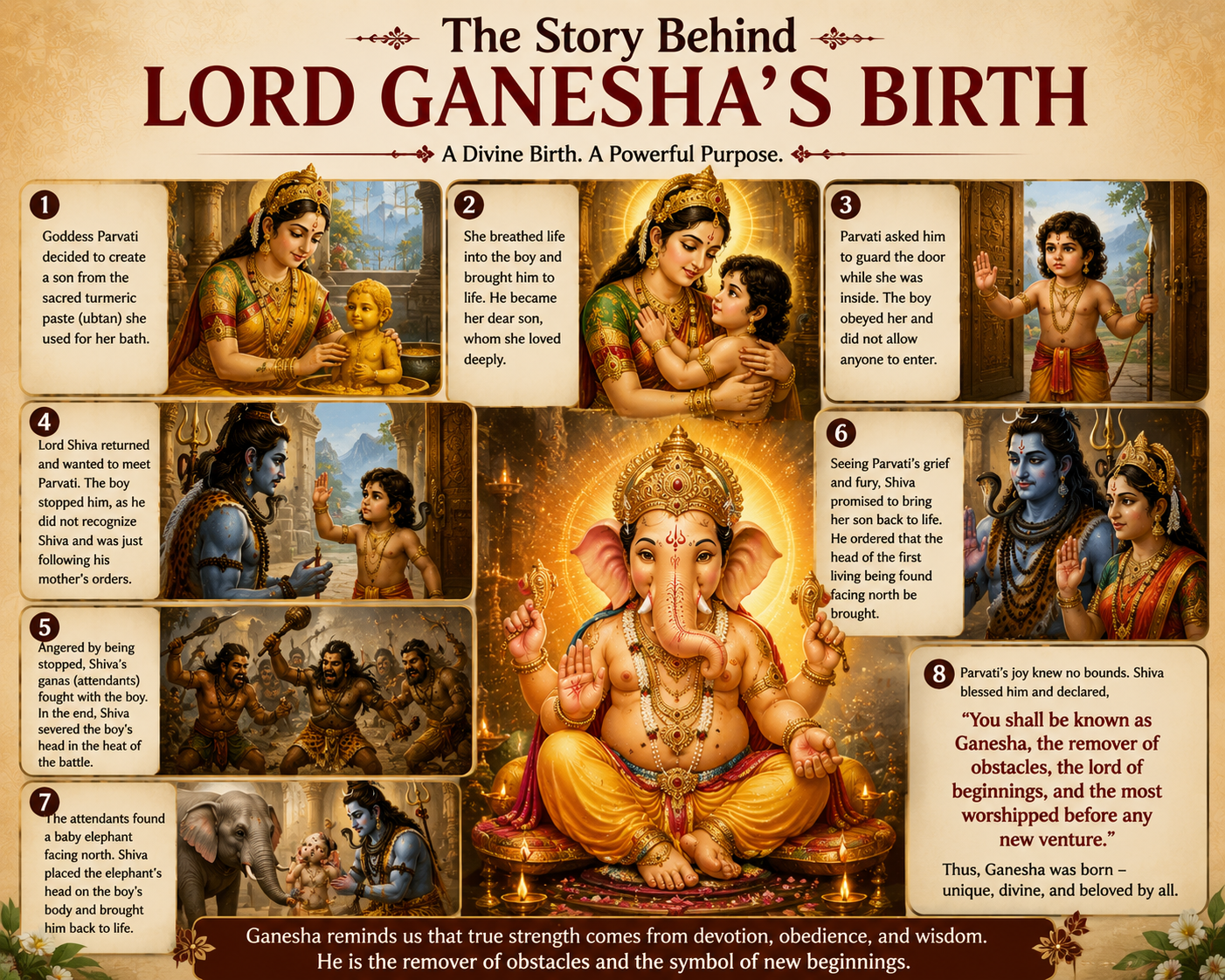
One of the most widely known stories about the origin of Lord Ganesha appears in Hindu mythology.
According to the traditional story, Goddess Parvati created Ganesha from the sandalwood paste or other material she used while bathing. She gave him life and asked him to guard the entrance while she bathed.
When Lord Shiva returned and attempted to enter, Ganesha stopped him because he did not know him and was following his mother’s instructions. A confrontation followed, and Lord Shiva eventually severed Ganesha’s head.
When Parvati discovered what had happened, she was devastated and demanded that Ganesha be brought back to life. To calm her, Lord Shiva promised to restore him. His followers were instructed to bring the head of the first living creature they encountered, which according to the story was an elephant.
Ganesha was then given the elephant’s head and brought back to life.
This story is one reason Lord Ganesha is traditionally depicted with an elephant’s head and a human body. Beyond the story itself, Ganesha’s distinctive form has inspired generations of artists, storytellers, and devotees.
Why Is Lord Ganesha Worshipped?
Lord Ganesha holds a special place in Hindu traditions and is often worshipped before beginning something important.
He is popularly known as Vighnaharta, meaning the remover of obstacles. At the same time, he is associated with wisdom, knowledge, prosperity, and good beginnings.
This is why people may pray to Ganesha before starting a new business, moving into a new home, beginning a journey, getting married, or undertaking an important project.
His appearance is also filled with symbolic meaning. His large ears are often associated with listening carefully, while his trunk represents adaptability and strength. His large belly is commonly interpreted as the ability to accept and digest the experiences of life.
For devotees, these ideas make Ganesha more than a deity associated with good fortune. He also represents qualities that people aspire to develop in their own lives.
The History of Public Ganesh Chaturthi Celebrations
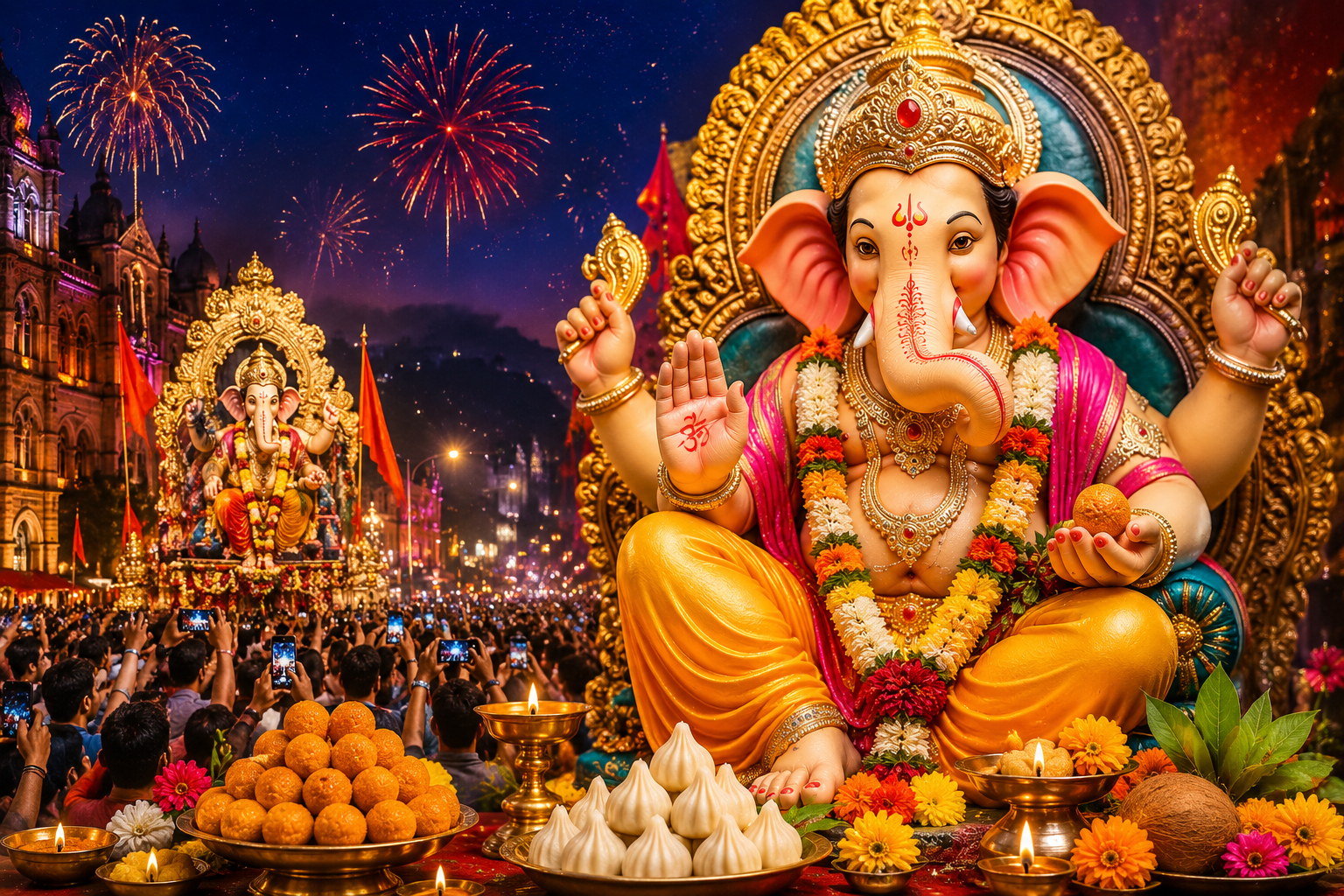
Although Ganesh worship has a long history in India, the form of large-scale public Ganesh Chaturthi celebrations seen today became particularly prominent in Maharashtra during the late 19th century.
Social reformer and freedom movement leader Bal Gangadhar Tilak played an important role in popularising public celebrations of the festival during the 1890s.
At a time when public gatherings were restricted under British rule, community celebrations provided an opportunity for people from different social backgrounds to come together.
Ganesh Chaturthi gradually became an important public festival in Maharashtra. What began as a religious celebration also became a platform for cultural programmes, music, speeches, social interaction, and community participation.
Over time, the tradition spread and evolved. Today, public Ganesh celebrations can be found in many Indian cities and among Indian communities around the world.
How Is Ganesh Chaturthi Celebrated?
Ganesh Chaturthi celebrations can vary considerably from one family, city, and region to another. However, several traditions are commonly associated with the festival.
1. Bringing the Ganesha Idol Home
For many families, the celebration begins with bringing a Ganesha idol home.
Choosing the idol can itself become a memorable family experience. Some people prefer traditional designs, while others choose artistic or contemporary forms. In recent years, many families have also started choosing clay idols and natural colours as part of more environmentally responsible celebrations.
The idol is placed in a specially decorated area of the home, often called a puja space.
2. Ganesh Sthapana
The installation of the Ganesha idol is known as Ganesh Sthapana.
The idol is placed on a decorated platform, and devotees perform rituals to welcome Lord Ganesha into their homes or community pandals.
Flowers, lamps, garlands, leaves, and other traditional decorations are commonly used.
For families, this ceremony can be a deeply personal moment. Children often participate in decorating the space, preparing offerings, and learning prayers from older family members.
3. Ganesh Puja
During the festival, devotees offer prayers to Lord Ganesha. Offerings may include flowers, fruits, sweets, incense, and other traditional items.
Aarti is another important part of the celebration. Family members and community members gather together, sing devotional songs, and participate in the prayer ceremony.
In public celebrations, the atmosphere can be much larger, with hundreds or thousands of people gathering for aarti.
सुखकर्ता दुःखहर्ता” गणपती आरती
सुखकर्ता दुःखहर्ता वार्ता विघ्नाची ।
नुरवी पुरवी प्रेम कृपा जयाची ॥
सर्वांगी सुंदर उटी शेंदुराची ।
कंठी झळके माळ मुक्ताफळांची ॥
जय देव जय देव जय मंगलमूर्ती ।
दर्शनमात्रे मनकामना पुरती ॥ जय देव जय देव ॥
रत्नखचित फरा तुज गौरीकुमरा ।
चंदनाची उटी कुंकुमकेशरा ॥
हिरेजडित मुकुट शोभतो बरा ।
रुणझुणती नूपुरे चरणी घागरिया ॥
जय देव जय देव जय मंगलमूर्ती ।
दर्शनमात्रे मनकामना पुरती ॥ जय देव जय देव ॥
लंबोदर पीतांबर फणिवरबंधना ।
सरळ सोंड वक्रतुंड त्रिनयना ॥
दास रामाचा वाट पाहे सदना ।
संकटी पावावे निर्वाणी रक्षावे सुरवरवंदना ॥
जय देव जय देव जय मंगलमूर्ती ।
दर्शनमात्रे मनकामना पुरती ॥ जय देव जय देव ॥
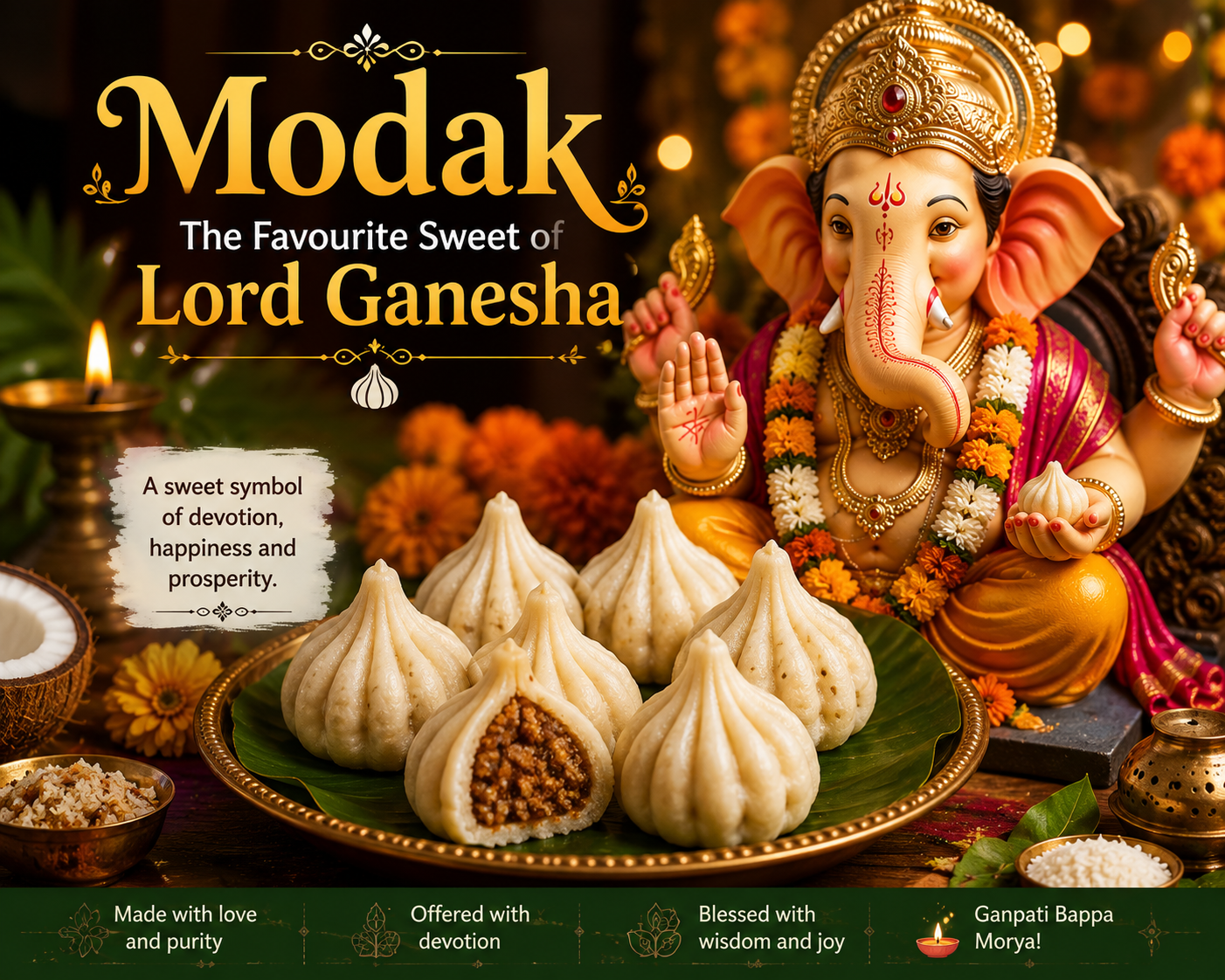
4. Modak — The Favourite Sweet of Lord Ganesha
No discussion of Ganesh Chaturthi feels complete without mentioning modak.
Modak is traditionally considered one of Lord Ganesha’s favourite sweets. It is prepared in several different ways depending on the region and family tradition.
A popular version is made with rice flour and filled with a mixture of coconut and jaggery. The filling is enclosed in a steamed dough covering, creating a soft and delicate sweet.
Today, you can find many variations, including fried modaks, chocolate modaks, dry-fruit modaks, and other modern interpretations.
For many families, preparing modaks together is as much a part of the celebration as the puja itself.
Ganesh Chaturthi Celebrations in Maharashtra
Maharashtra is particularly famous for its grand Ganesh Chaturthi celebrations.
Cities such as Mumbai, Pune, and Nagpur see large-scale festivities during the season. In Mumbai especially, Ganesh Chaturthi transforms neighbourhoods across the city.
Community groups known as Ganesh mandals organise elaborate pandals, decorations, cultural programmes, and daily prayers.
Some Ganesha idols become famous across the city and attract large crowds of devotees and visitors.
The atmosphere is a unique combination of devotion and celebration. Streets are decorated with lights and flowers, drums accompany processions, and families visit different pandals to seek blessings.
For visitors, Ganesh Chaturthi also provides an opportunity to experience an important part of Maharashtra’s cultural life.
Famous Ganesh Celebrations in Mumbai
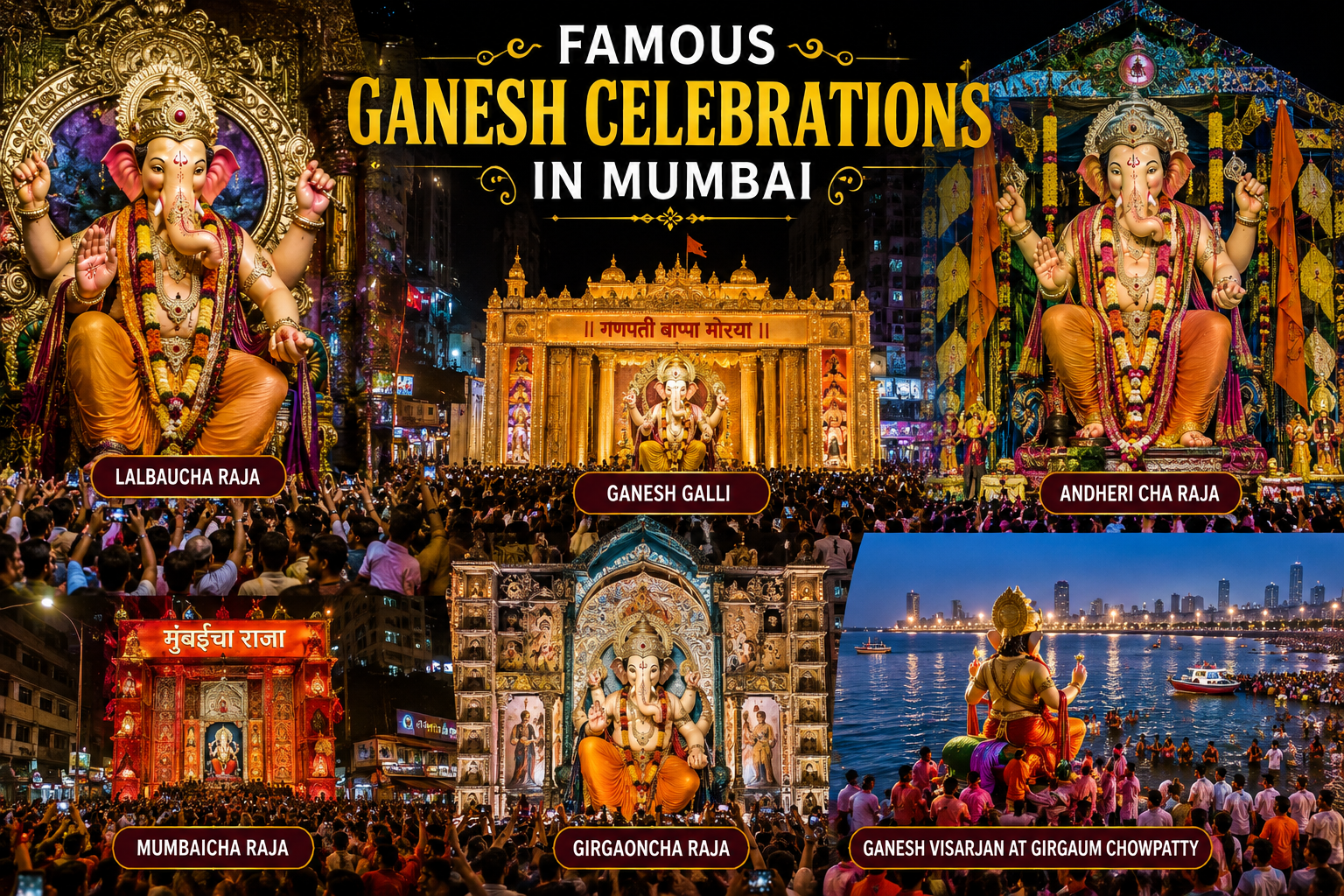
Mumbai’s Ganesh Chaturthi is known for its enormous public participation.
Among the city’s well-known Ganesh traditions are the idols and mandals that attract devotees from different parts of Mumbai and beyond. Some have been part of the city’s festive culture for generations.
Visitors often spend several days exploring different neighbourhoods and pandals. Each celebration may have its own theme, decoration style, social initiatives, and artistic interpretation of Lord Ganesha.
However, anyone visiting during the festival should remember that popular locations can become extremely crowded, particularly during weekends and the final immersion processions.
The best way to experience the festival is to combine enthusiasm with patience and respect for devotees who are participating in religious rituals.
Ganesh Visarjan: The Emotional Farewell
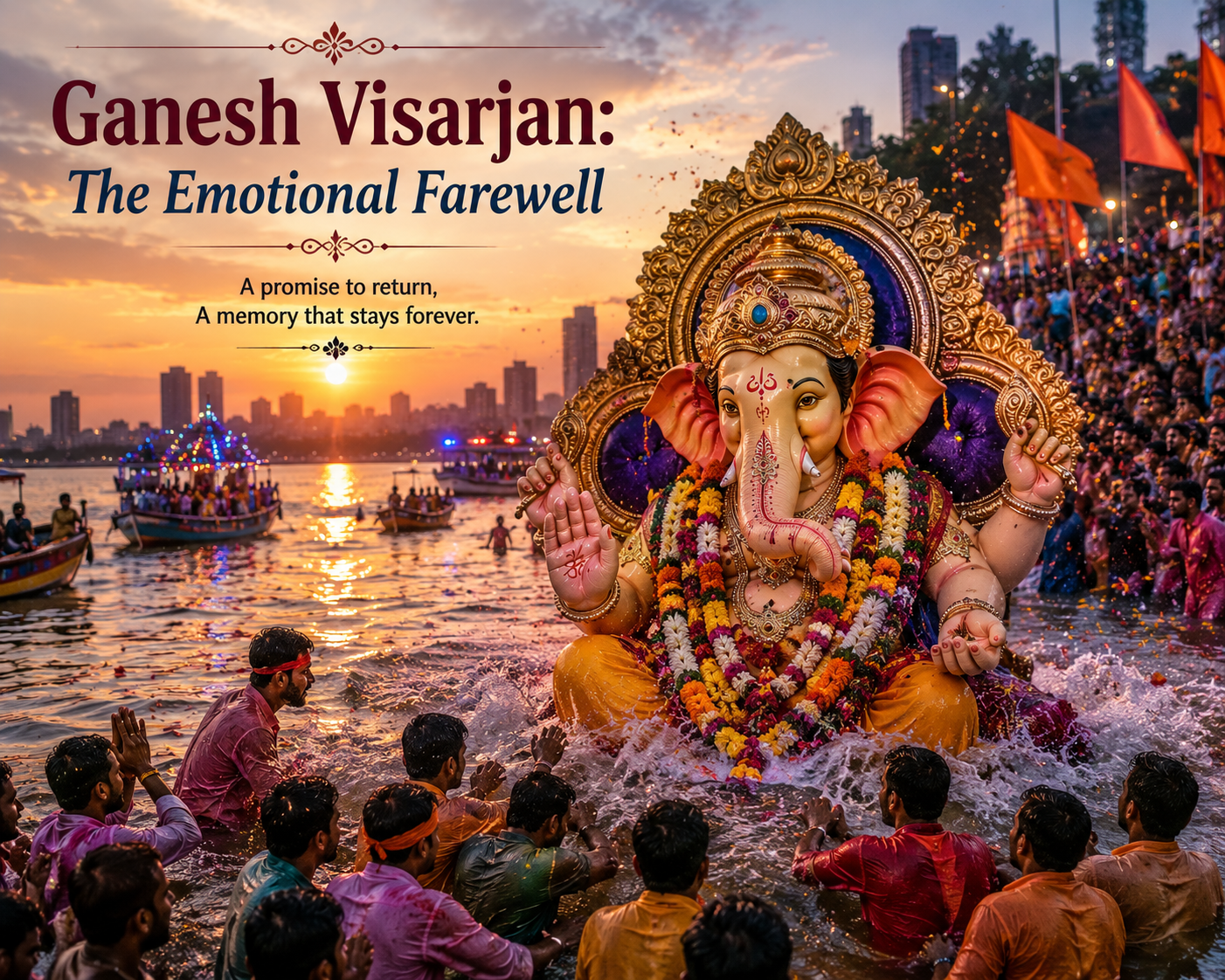
One of the most memorable parts of Ganesh Chaturthi is Ganesh Visarjan, the immersion of the idol.
After the period of worship comes to an end, devotees carry the Ganesha idol in a procession toward a water body.
The procession is often accompanied by music, dancing, drums, and chants of devotion. In Maharashtra, the traditional chant “Ganpati Bappa Morya” can be heard throughout the streets.
For many devotees, visarjan is an emotional moment. They have welcomed the idol into their homes, worshipped it, and celebrated with it for several days. Saying goodbye can therefore feel deeply personal.
Yet the farewell carries an important philosophical message.
The idol, which represents the divine, eventually dissolves back into nature. The process reminds people of the temporary nature of physical existence and the importance of accepting the cycle of creation, preservation, and dissolution.
Ganesh Chaturthi Beyond Maharashtra
Although Maharashtra is strongly associated with Ganesh Chaturthi, the festival is celebrated in many other parts of India.
In Karnataka, the festival is known as Gowri-Ganesha in many communities, with celebrations involving both Goddess Gowri and Lord Ganesha.
In Andhra Pradesh and Telangana, devotees celebrate Vinayaka Chavithi with prayers, decorations, and offerings.
In Tamil Nadu, Ganesha idols are installed in homes and public spaces, and devotees offer traditional foods and prayers.
In Goa, Ganesh Chaturthi is an important family festival, with many households observing traditions passed down through generations.
The celebrations may look different from one state to another, but the central spirit remains similar: devotion, family, community, and the welcoming of Lord Ganesha.
The Cultural Importance of Ganesh Chaturthi
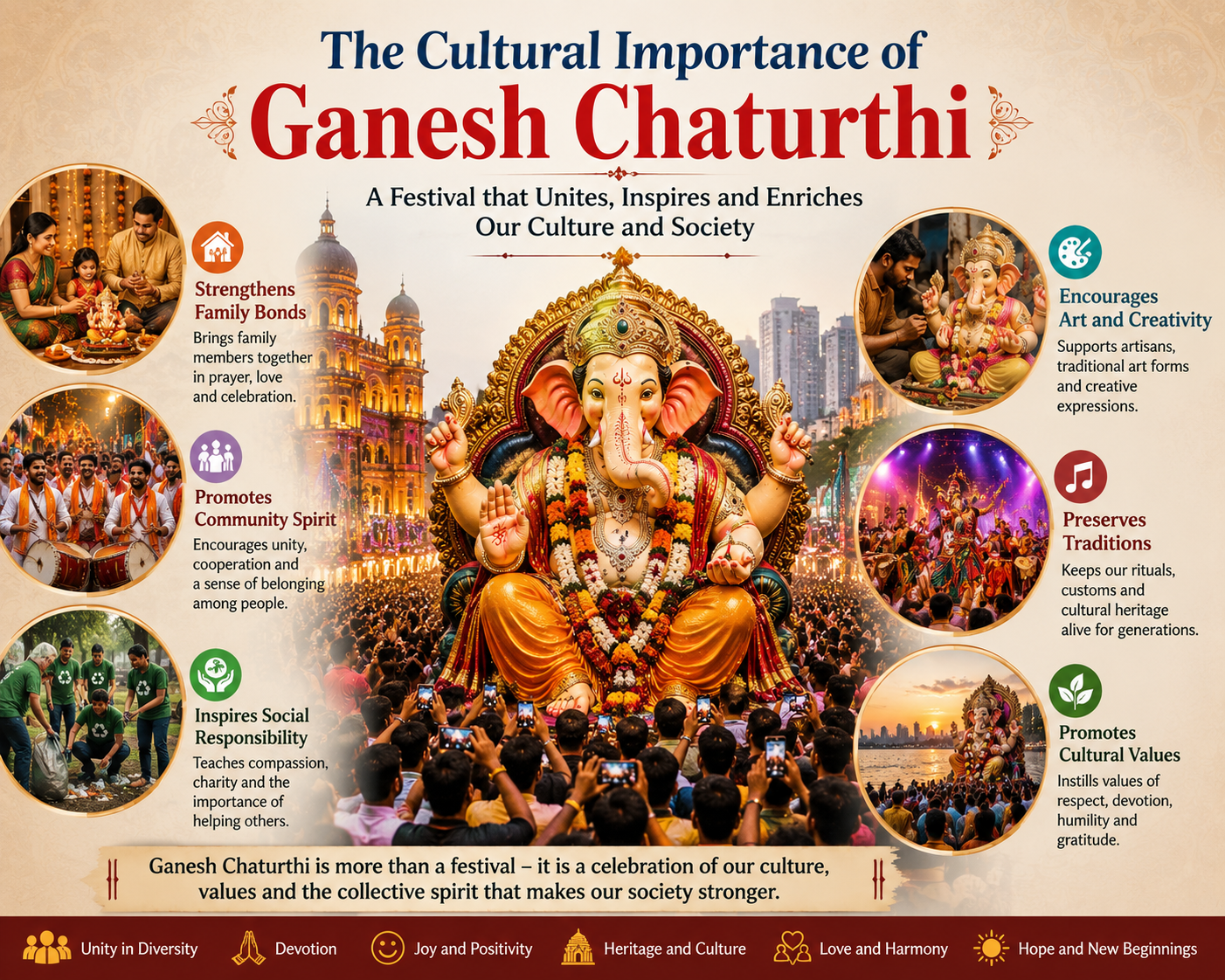
Ganesh Chaturthi has grown into much more than a religious festival.
It creates opportunities for communities to work together. People contribute money, time, creativity, and organisational skills to build pandals and arrange events.
Artists create elaborate Ganesha idols and decorations. Musicians and performers participate in cultural programmes. Local businesses benefit from increased activity during the festive season.
The festival also creates a bridge between generations.
Grandparents share stories and traditions with children. Parents teach younger family members how to perform rituals. Children participate in decorations and cultural activities.
In this way, Ganesh Chaturthi helps keep cultural traditions alive while allowing each generation to add its own interpretation.
The Rise of Eco-Friendly Ganesh Chaturthi
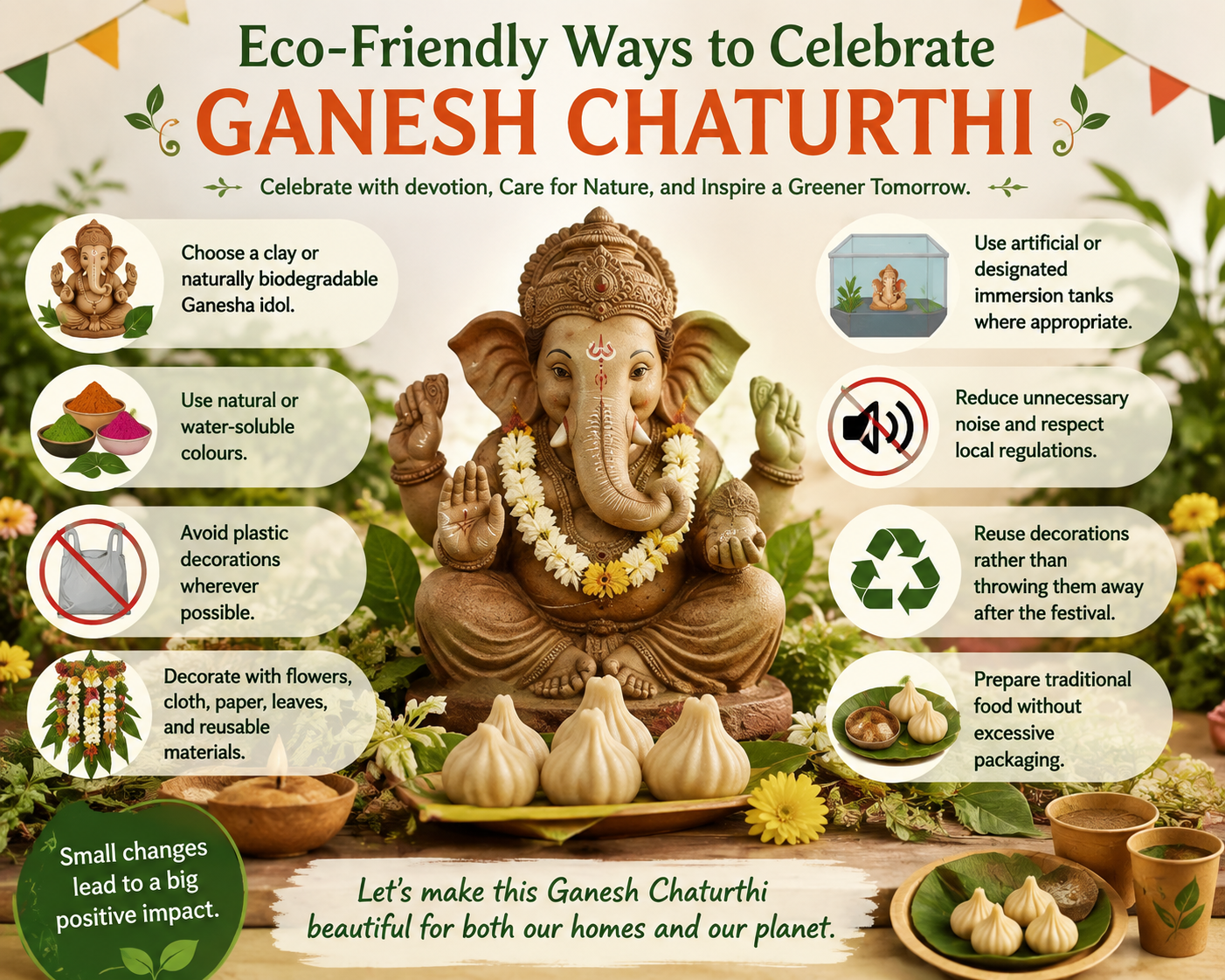
One of the biggest changes in recent years has been the growing awareness of environmentally friendly celebrations.
Traditionally, many Ganesha idols were made using materials that could take longer to dissolve in water. Some paints and decorative materials could also contribute to water pollution.
This has encouraged devotees, artists, communities, and environmental groups to look for alternatives.
Eco-friendly ways to celebrate Ganesh Chaturthi include:
- Choosing a clay or naturally biodegradable Ganesha idol.
- Using natural or water-soluble colours.
- Avoiding plastic decorations wherever possible.
- Decorating with flowers, cloth, paper, leaves, and reusable materials.
- Using artificial or designated immersion tanks where appropriate.
- Reducing unnecessary noise and respecting local regulations.
- Reusing decorations rather than throwing them away after the festival.
- Preparing traditional food without excessive packaging.
An eco-friendly celebration does not have to be less beautiful or meaningful. In fact, it can make the festival even more meaningful by connecting devotion with responsibility toward nature.
Ganesh Chaturthi and Community Spirit
One of the most beautiful aspects of the festival is its ability to bring people together.
During the celebrations, neighbours who may not interact regularly often meet at local pandals. Families visit each other. Volunteers organise events and help manage crowds.
Many community groups also use the festival as an opportunity to support social causes. Some organise health camps, blood donation drives, educational initiatives, food distribution, or charity activities.
This community spirit reflects an important aspect of the festival: celebration is not only about receiving blessings but also about sharing happiness with others.
How to Celebrate Ganesh Chaturthi Responsibly
Whether you are celebrating at home or visiting public pandals, a few simple choices can make the festival more enjoyable and responsible.
Keep the celebration focused on what matters most rather than competing over the size or expense of decorations.
If you are installing an idol, consider choosing an eco-friendly option. Keep decorations reusable wherever possible.
When visiting public celebrations, respect queues, follow instructions from volunteers, and avoid disturbing people during prayers.
If you are attending a visarjan procession, be mindful of crowds and follow local safety instructions.
Most importantly, remember that the essence of Ganesh Chaturthi lies in devotion, togetherness, gratitude, and the joy of celebrating with others.
Frequently Asked Questions About Ganesh Chaturthi
Why is Ganesh Chaturthi celebrated?
Ganesh Chaturthi celebrates the birth of Lord Ganesha. Devotees worship him as the remover of obstacles and as a symbol of wisdom, prosperity, and auspicious beginnings.
How many days is Ganesh Chaturthi celebrated?
The duration varies between families and communities. Some celebrate for one or a few days, while many public celebrations traditionally continue for several days and culminate on Anant Chaturdashi.
What is Ganesh Visarjan?
Ganesh Visarjan is the ritual immersion of the Ganesha idol in water at the end of the celebration. It symbolises the return of the deity to his divine abode and the cycle of creation and dissolution.
What food is traditionally prepared during Ganesh Chaturthi?
Modak is one of the most popular foods associated with the festival. Families may also prepare other sweets, savoury dishes, fruits, and regional festive foods as offerings and for family meals.
Why is modak associated with Lord Ganesha?
Traditional Hindu stories and popular devotional traditions associate modak with Lord Ganesha as a favourite sweet. It has therefore become an important part of Ganesh Chaturthi offerings.
Where is Ganesh Chaturthi celebrated?
Ganesh Chaturthi is celebrated across India, with particularly large and famous celebrations in Maharashtra. It is also celebrated by Indian communities in other countries.
The Spirit of Ganesh Chaturthi
Ganesh Chaturthi brings together many different aspects of Indian culture — faith, family, food, music, art, community, and tradition.
For some, it is a quiet family celebration at home. For others, it is the excitement of visiting neighbourhood pandals and joining thousands of devotees. For artists, it is an opportunity to create beautiful idols and decorations. For communities, it is a chance to come together and help one another.
But beneath all these different forms is the same message.
Lord Ganesha is welcomed with love, worshipped with devotion, and eventually bid farewell with the understanding that nothing remains unchanged forever.
As the familiar chant of “Ganpati Bappa Morya” fills the air during the celebrations, it captures the emotional heart of the festival — joy in welcoming Ganesha and hope for his return.
Ganesh Chaturthi is therefore not simply a festival on the calendar. It is an experience that brings people together, keeps traditions alive, and reminds us to welcome new beginnings while learning to let go with grace.
Conclusion
Ganesh Chaturthi is one of India’s most vibrant and meaningful festivals. Its combination of mythology, devotion, family traditions, community celebrations, music, art, and food makes it unique.
From the moment the Ganesha idol enters a home to the emotional farewell during visarjan, every stage of the festival carries its own significance.
As celebrations continue to evolve, the spirit of Ganesh Chaturthi remains constant: welcome with love, celebrate together, remove obstacles, and embrace new beginnings.
Whether celebrated in a small home or among thousands of people at a public pandal, Ganesh Chaturthi continues to hold a special place in the hearts of millions of people.
Ganpati Bappa Morya!